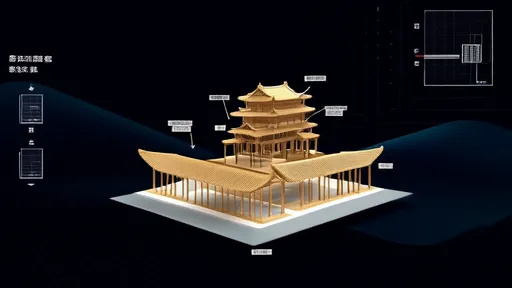
Simulating Ancient Architectural Structures with Physics Engines
The ancient world has left behind architectural marvels that continue to baffle modern engineers. From the towering pyramids of Egypt to the intricate wooden pagodas of East Asia, these structures have withstood the test of time despite being built without the computational tools available today. Now, researchers are turning to physics engines—software traditionally used for video games and CGI—to unravel the secrets of their durability. By simulating forces like gravity, wind, and seismic activity, scientists are gaining unprecedented insights into how these buildings remain standing centuries after their construction.
Physics engines, once confined to the realm of digital entertainment, are proving invaluable in structural analysis. Originally developed to create realistic movement in video games, these programs calculate how objects interact under various physical conditions. When applied to ancient architecture, they allow researchers to model stress points, load distribution, and material behavior with startling accuracy. For instance, simulations of Roman aqueducts have revealed how their arched design redistributes weight to prevent collapse, while analyses of Japanese temple joints show how intricate woodwork absorbs seismic energy.
The process begins with creating a precise digital replica of the structure. Laser scanning and photogrammetry capture every detail, from the texture of stone blocks to the angle of wooden beams. This model is then imported into physics engines like NVIDIA PhysX or Bullet, where material properties are assigned based on historical records and modern testing. Researchers can then introduce virtual forces—simulating everything from routine weathering to catastrophic earthquakes—and observe how the structure responds. These simulations often confirm long-held theories about ancient engineering while occasionally revealing completely unexpected load-bearing mechanisms.
One remarkable finding involves the Hagia Sophia's seismic resilience. Physics engine simulations demonstrated how the building's massive dome, often considered vulnerable, actually works with its supporting arches to create a dynamic system that dissipates energy during earthquakes. The model showed that slight movements in the substructure prevent resonant frequencies from building up, a principle that modern architects are now studying for contemporary earthquake-proof designs. Similarly, analysis of the Leaning Tower of Pisa explained why it hasn't toppled—the soft soil that caused its tilt also absorbs vibrations that would otherwise destabilize it.
Beyond understanding historical techniques, these simulations aid preservation efforts. Conservators use the data to identify which parts of ancient structures are most vulnerable to modern environmental stressors like pollution or increased rainfall. For example, simulations of Angkor Wat's sandstone blocks revealed how centuries of mineral leaching have altered their load-bearing capacity, guiding restoration teams to reinforce specific areas before they fail. The technology also helps test proposed restoration methods virtually before applying them to priceless heritage sites.
The fusion of gaming technology and architectural archaeology isn't without challenges. Ancient construction materials often had inconsistent properties due to primitive manufacturing techniques, requiring researchers to input ranges rather than fixed values into simulations. Additionally, some traditional building methods—like the use of organic binders in mortar—have compositions that remain partially unknown, leaving gaps in the digital models. Nevertheless, as physics engines become more sophisticated and computational power increases, these limitations are gradually being overcome.
Looking ahead, researchers anticipate physics engines will unlock further secrets of ancient engineering. Planned studies aim to simulate entire cities rather than individual buildings, examining how urban layouts influenced structural stability. Others will focus on temporary structures—like siege towers or ceremonial pavilions—that left no physical traces but were described in historical texts. As this technology evolves, it may finally answer how civilizations without modern science achieved feats that sometimes surpass what contemporary engineering can explain.
This innovative application of physics engines represents more than academic curiosity. By decoding ancient builders' empirical knowledge, today's engineers are discovering sustainable construction principles that endured for millennia. The simulations highlight solutions to modern challenges like earthquake resilience and material efficiency—proving that the past still holds valuable lessons for the future of architecture. As one researcher noted, "We're not just preserving history; we're mining it for breakthroughs that could shape how we build tomorrow."